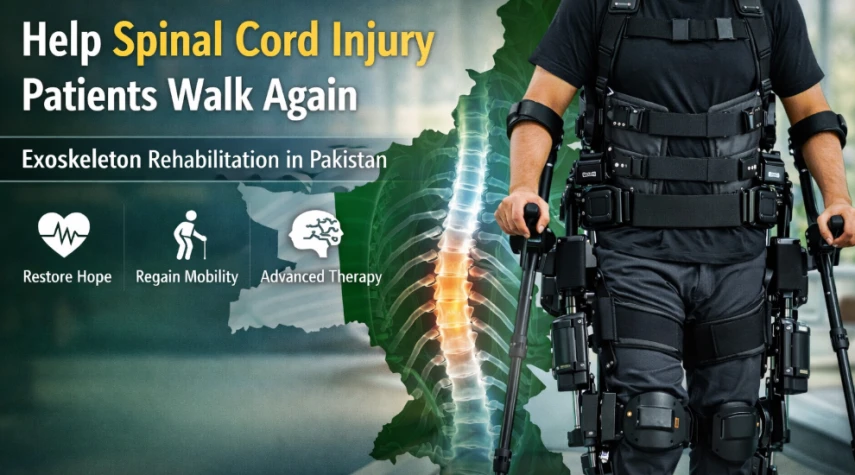
ROBOTIC EXOSKELETON REHABILITATION FOR SPINAL CORD INJURY (SCI) PATIENTS IN PAKISTAN
Restoring hope. Restoring movement.
Every year in Pakistan, thousands of people suffer spinal cord injuries due to road accidents, falls, violence, and medical conditions.
For many of them, walking again becomes an impossible dream.
But modern rehabilitation technology has changed that.
Robotic exoskeleton therapy allows patients with spinal cord injuries to stand, walk, and retrain their nervous system, improving mobility, circulation, independence, and quality of life.
Unfortunately, this advanced rehabilitation technology is not accessible to most patients in Pakistan due to extremely high costs.
Through this campaign, we aim to introduce exoskeleton-assisted rehabilitation therapy to help spinal cord injury patients regain mobility and dignity.
THE STORY
I am a Physical Therapist with a Master’s degree in Neuro-Muscular Physical Therapy, working with patients suffering from neurological conditions such as spinal cord injuries, stroke, and traumatic brain injuries.
Throughout my clinical experience, I have seen the physical and emotional suffering of patients who lose their ability to walk.
Many of these individuals are young adults who were active and independent before their injury.
Unfortunately, rehabilitation services in Pakistan often lack advanced technology that is available in developed countries, such as robotic rehabilitation systems and exoskeleton therapy.
Every day I see patients who want to stand again, walk again, and regain independence, but the tools needed to help them achieve that are simply not available or affordable.
That is why I want to bring robotic exoskeleton rehabilitation technology to Pakistan, so patients here can benefit from the same life-changing therapy available in leading rehabilitation centers worldwide.
THE IDEA BEHIND THIS PROJECT
The goal of this project is to establish a robotic exoskeleton rehabilitation program for spinal cord injury patients.
Exoskeleton devices are wearable robotic systems that allow patients with paralysis to:
• Stand upright
• Practice walking
• Improve muscle activation
• Enhance circulation and bone health
• Stimulate neuroplasticity and neural recovery
Research shows that robotic rehabilitation can significantly improve functional outcomes in neurological patients.
Through this project we aim to:
• Provide robot-assisted walking therapy
• Improve rehabilitation outcomes for spinal cord injury patients
• Reduce long-term disability
• Improve mental health and independence of patients
WHY THIS MATTER IN PAKISTAN
Pakistan has limited access to advanced neurological rehabilitation technologies.
Many patients:
• Cannot afford treatment abroad
• Have limited access to specialized rehabilitation centers
• Spend years confined to wheelchairs
By introducing exoskeleton therapy, we can bring world-class rehabilitation technology to patients who need it the most.
This program can also help create awareness about modern neurorehabilitation techniques in Pakistan.
HOW IT WORKS
The funds raised will help us:
1️⃣ Purchase a robotic exoskeleton rehabilitation device
2️⃣ Train rehabilitation professionals to use this technology safely.
3️⃣ Provide structured rehabilitation programs for spinal cord injury patients
4️⃣ Offer subsidized treatment for low-income patients
5️⃣ Develop a specialized neuro-rehabilitation unit
Patients will undergo supervised therapy sessions conducted by trained rehabilitation professionals.
WHY ApnaCrowdfunding
Advanced rehabilitation technology such as exoskeleton systems is extremely expensive.
Through ApnaCrowdfunding, we hope to bring together people who believe in supporting healthcare innovation and improving the lives of patients living with paralysis.
Your support can help bring life-changing rehabilitation technology to Pakistan.
FUNDING GOAL
Target: PKR 5,000,000
Allocation:
PKR 2,000,000 – Purchase of multiple robotic exoskeleton rehabilitation devices for spinal cord injury patients.
PKR 900,000 – Advanced training and certification for rehabilitation professionals to safely operate robotic rehabilitation systems.
PKR 800,000 – Setup of a specialized rehabilitation facility including safety systems, therapy equipment, and patient support infrastructure.
PKR 600,000 – Patient rehabilitation subsidy fund to support treatment for underprivileged spinal cord injury patients.
PKR 400,000 – Research and development for improving neuro-rehabilitation programs and treatment protocols in Pakistan.
PKR 300,000 – Awareness campaigns, community outreach, and educational workshops for spinal cord injury prevention and rehabilitation.